
By Dana Hillig, Colorado Realtor®, Hillig Homes
At First Glance
Highlands Ranch is a master-planned community in Douglas County, just south of Denver, that almost always surprises relocators with how much it actually delivers for the HOA fee. About 100,000 residents live there, spread across distinct neighborhood “ridges” with their own character. The community includes four full recreation centers, 8,200 acres of preserved open space (the Backcountry Wilderness Area, larger than Boulder’s mountain parks), 70+ miles of trails, one of the most consistently well-regarded school districts in the Denver metro (Douglas County School District), and HOA dues that are unusually low for what they cover. The 2026 median single-family home price sits around $725,000-$750,000. If you want a family-friendly community with built-in amenities, structured neighborhoods, and easy outdoor access, Highlands Ranch is one of the best-positioned suburbs in the Denver metro. If you want historic charm or walkable downtown energy, this is not that suburb.
Why This Matters
Most relocators arrive at Highlands Ranch with a stereotype, “another suburban HOA community,” and that stereotype usually dissolves the moment they see what the HOA actually includes. The HRCA (Highlands Ranch Community Association) annual dues are remarkably low compared to typical Denver-area HOAs, and they cover four recreation centers, 8,200 acres of open space, 70+ miles of trails, and a constant calendar of community events.
For first-time buyers and Colorado relocators looking at Denver, Littleton, Highlands Ranch, Centennial, Parker, Lone Tree, and other south Denver suburbs, Highlands Ranch is a near-perfect fit if any of these match your situation:
- You are a family that wants structured kid-friendly amenities built in
- You are an outdoor person who wants 8,200 acres of trails minutes from your door
- You value newer housing stock and consistent neighborhood maintenance
- You want strong public schools (Douglas County School District) without paying private
- You appreciate community structure, organized events, and clear HOA rules
Highlands Ranch is less of a fit if you want historic character, walkable downtown energy, the lowest price point in the metro, or maximum architectural freedom on your own home.
A Real Moment I See Often
A relocator family from California tours four south Denver suburbs. Day one, they drive through Highlands Ranch and dismiss it. “Too HOA-heavy. Too planned. Looks like every other suburb.”
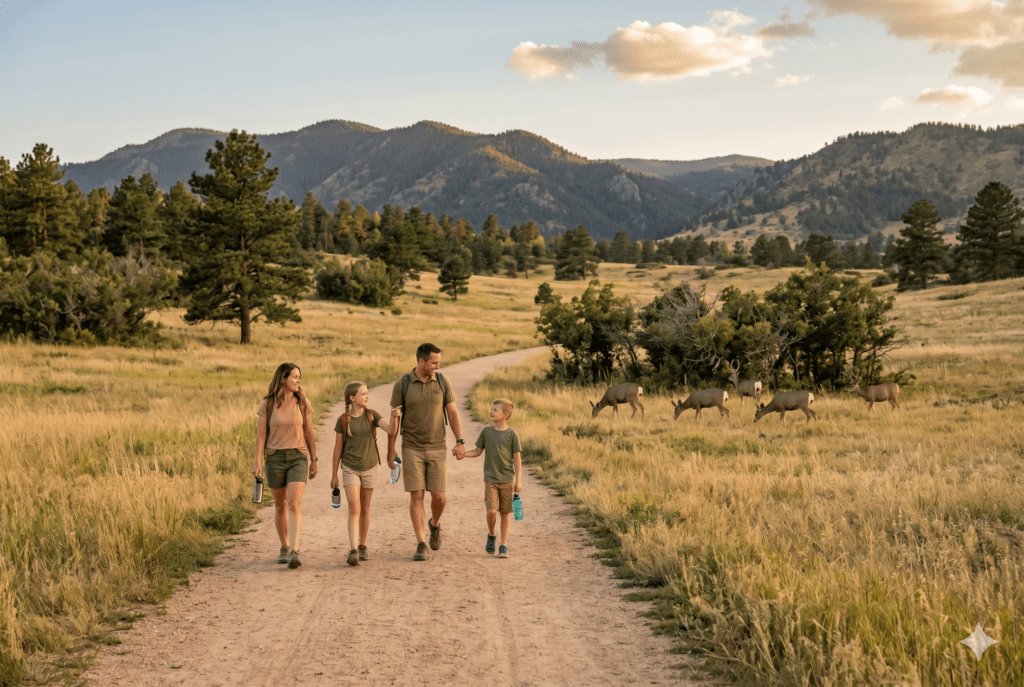
Day two, I take them to the Backcountry Wilderness Area trailhead off Town Center Drive. They walk a half mile in. Native grasses. Mule deer in the distance. Trail extending toward the foothills. Their kids ask if they can stay longer.
That afternoon we visit the Eastridge Recreation Center, included with the HOA. Indoor pool, climbing wall, three full gyms, fitness studios. The wife turns to me: “Wait, all of this is included? What is the HOA fee?”
I tell her. She has to ask me to repeat it.
By dinner, Highlands Ranch is on their short list. The stereotype dissolves once relocators actually see the system underneath. Most do not know any of this exists until someone shows them. That is what I see almost every time.
What Can Help
What Highlands Ranch Actually Is (and Is Not)
Highlands Ranch is a master-planned community in unincorporated Douglas County. It was launched in 1981 by the Mission Viejo Company and has grown into one of the most successful master-planned communities in the country. It is not technically a city. There is no Highlands Ranch city government. The day-to-day “city” functions are split between Douglas County (roads, public services, sheriff) and the HRCA (parks, trails, rec centers, community events).
This matters because it means:
- Property taxes go to Douglas County (often lower than Arapahoe County to the north)
- Schools are part of the Douglas County School District (consistently well-rated)
- Community amenities are funded through HRCA dues, not municipal taxes
- There is no Highlands Ranch mayor or city council. Decisions come through HRCA and Douglas County
The Four “Ridges” – Highlands Ranch’s Neighborhood Structure
Highlands Ranch is divided into four main “ridges” plus newer additions. Each has its own character:
- Northridge – the oldest and first developed (1980s-90s), closer to C-470, more established trees and mature landscaping. Family homes in the $550K-$750K range.
- Eastridge – the central hub, anchored by the Highlands Ranch Town Center, the Highlands Ranch Mansion, and Eastridge Recreation Center. A mix of 1990s and 2000s homes. Strong walkability to amenities.
- Southridge – newer development, family-oriented, near Southridge Rec Center. 2000s-era homes mostly.
- Westridge – newer still, foothills views, modern homes. Often $700K-$1M+.
- BackCountry (technically the newest area) – luxury master-planned subset bordering the Backcountry Wilderness Area. Higher price points, often $1M+. Additional sub-HOA on top of HRCA.
When relocators ask “should we look at Highlands Ranch,” the better question is which ridge fits the lifestyle.
What the HRCA Membership Actually Includes
Here is the part that surprises most relocators. For one annual HRCA fee (currently in the low three figures, refresh with your Realtor for exact 2026 number, plus any sub-HOA fees on specific neighborhoods), HRCA membership includes:
- Four full recreation centers (Eastridge, Westridge, Northridge, Southridge) with pools, gyms, fitness classes, climbing walls, and indoor courts
- 70+ miles of trails across the community
- 8,200 acres of Backcountry Wilderness Area with hiking, mountain biking, and wildlife viewing
- Hundreds of free community events annually (concerts, holiday festivals, classes)
- Architectural and landscape maintenance standards that keep the community looking consistently well-kept
- Use of the Highlands Ranch Mansion grounds for community events
For the math: if you and your family would use a gym, pool, and trail system, the cost-per-use math on the HRCA fee makes the typical Denver-area gym membership look expensive by comparison.
The Backcountry Wilderness Area, Specifically
The Backcountry Wilderness Area is the underrated feature of Highlands Ranch. It is 8,200 acres of preserved open space, larger than Boulder Mountain Park. It includes:
- Miles of multi-use trails open to hikers, runners, and mountain bikers
- Native wildlife including mule deer, elk, mountain lions (rare but real), and over 200 bird species
- Educational programs through HRCA
- Some of the only “wild” foothills hiking inside a Denver suburb
Most relocators do not know it exists until someone shows them.
Schools (Douglas County School District)
Highlands Ranch is served by the Douglas County School District (DCSD), one of the most consistently well-rated districts in the Denver metro. The community has multiple high schools serving different parts of HR:
- Highlands Ranch High School (Northridge area)
- Mountain Vista High School (Southridge area)
- ThunderRidge High School (Eastridge area)
- Rock Canyon High School (Westridge / BackCountry area)
Each high school feeds from multiple middle and elementary schools. For relocator families, school assignment is by specific address, so always confirm the school feeder pattern for the exact home you are considering.
Commute and Connectivity
- To downtown Denver: 25-35 minutes off-peak via I-25, 40-55 minutes during rush hour
- To DTC (Denver Tech Center): 10-15 minutes via Lucent Boulevard and I-25
- To DIA (airport): 35-45 minutes via E-470 (toll road)
- To the foothills/mountains: C-470 to I-70 puts you in the foothills in 25-30 minutes
- Light rail: the closest stations are in nearby Lone Tree (Lincoln Station) and Centennial. HR itself does not have light rail
If you commute to north Denver or Boulder daily, Highlands Ranch is going to feel far. If you work in DTC, it is one of the easier commutes in the metro.
Housing Variety and Price Point
The 2026 median single-family home price in Highlands Ranch sits around $725,000-$750,000. What that buys varies by ridge:
- Northridge (older, established): family homes from $550K-$750K
- Eastridge (central): mix of mid-2000s family homes, $600K-$850K
- Southridge (newer): $700K-$950K range
- Westridge (newer, foothills views): often $750K-$1.1M
- BackCountry (luxury): $1M-$3M+
- Townhomes and condos are limited compared to other suburbs but available, generally $450K-$650K
Highlands Ranch is generally priced higher than Littleton and lower than Lone Tree.
What Locals Actually Love About Living There
When I ask my Highlands Ranch clients what they love after a year of living there:
- The Backcountry Wilderness Area
- The recreation centers (the “we get a gym AND a pool for the kids” reality)
- Schools (for families)
- Trail access from almost every neighborhood
- Community events
- Highlands Ranch Mansion and Town Center events
- General sense of “things are well taken care of”
Honest Tradeoffs
The honest tradeoffs to know going in:
- HOA architectural rules. Paint colors, fences, sheds, landscaping changes require HRCA approval. Some buyers love this (consistency). Some find it restrictive.
- Master-planned uniformity. Some neighborhoods feel similar in architecture. If you want a one-of-a-kind home or a quirky street, Highlands Ranch is not the best fit.
- No walkable downtown. The Town Center is car-oriented retail. There is no equivalent of downtown Littleton’s Main Street.
- Traffic. Lucent Boulevard and C-470 get busy. Plan around it.
- Sub-HOAs. Some specific neighborhoods (especially BackCountry and luxury sections) have additional HOA fees beyond the base HRCA dues.
- Hail. Denver metro is one of the most hail-prone regions in the country, and HR is no exception.
Common Things That Trip Buyers Up
- Confusing Highlands Ranch with a city. It is unincorporated Douglas County. There is no city government. HRCA handles the community.
- Underestimating the value of the HOA membership. Most relocators write off HOAs based on bad experiences elsewhere. HR’s HRCA is genuinely unusual in what it delivers per dollar.
- Missing sub-HOA fees. Some specific neighborhoods (BackCountry especially) have additional HOAs on top of HRCA. Always confirm total monthly/annual HOA costs for the specific home.
- Not driving the commute. The drive from HR to your actual workplace at your actual time is the only commute test that matters.
- Confusing “ridges.” Different ridges feel like different communities. Tour at least two ridges before deciding.
- Skipping the rec centers. Most relocators tour homes and skip the amenities. Visit Eastridge Rec Center at least once before deciding. It changes the math for most families.
FAQ
Is Highlands Ranch a city?
No. Highlands Ranch is an unincorporated census-designated place in Douglas County. There is no Highlands Ranch city government. Services are provided by Douglas County and the Highlands Ranch Community Association (HRCA).
What does the HRCA fee include in 2026?
The annual HRCA membership covers four recreation centers (Eastridge, Westridge, Northridge, Southridge), 70+ miles of trails, the Backcountry Wilderness Area, community events, and architectural and landscape maintenance standards. Confirm the exact 2026 annual amount with your Realtor or lender, since the fee is set annually by HRCA. Some sub-HOAs in specific neighborhoods (like BackCountry) charge additional fees.
How are the schools in Highlands Ranch?
Strong. Highlands Ranch is served by Douglas County School District (DCSD), one of the most consistently well-rated districts in the Denver metro. There are four main high schools serving different parts of HR (Highlands Ranch HS, Mountain Vista, ThunderRidge, Rock Canyon). School assignment is by specific address, so always confirm the feeder pattern for any home you are considering.
What is the median home price in Highlands Ranch in 2026?
Around $725,000-$750,000 for a single-family home, varying meaningfully by ridge. Older Northridge homes can start lower, BackCountry luxury homes run over $1M, and the bulk of the market sits in the $650K-$900K range for single-family.
Is Highlands Ranch better than Littleton for families?
It depends on what you value. Highlands Ranch wins on built-in amenities, structured trails, rec centers, and Douglas County Schools. Littleton wins on historic downtown character, light rail access to downtown Denver, and (often) lower price points. Many families I work with tour both and choose based on which lifestyle resonates more.
What is the Backcountry Wilderness Area?
8,200 acres of preserved open space on the south and west sides of Highlands Ranch, larger than Boulder Mountain Park. It includes miles of multi-use trails (hiking, running, mountain biking), native wildlife habitat, and educational programs. Access is managed through HRCA membership. It is one of the most underrated features of HR for outdoor-focused relocators.
Are there pet rules in Highlands Ranch?
HRCA has general community standards (leash laws, pet waste, noise) that align with Douglas County rules. Specific neighborhoods or sub-HOAs may have additional rules. Most of Highlands Ranch is dog-friendly with a strong trail-walking culture.
What is the best ridge in Highlands Ranch?
Each ridge has different strengths. Northridge for mature trees and established feel, Eastridge for centrality to the Town Center and Mansion, Southridge for newer homes at family price points, Westridge for foothills views, BackCountry for luxury and wilderness access. The “best” depends on commute, school feeder, budget, and lifestyle.
Final Thoughts
Highlands Ranch is a master-planned community that actually delivers on the master-planned promise. It is best understood as a system, the HRCA membership plus the rec centers plus the trails plus the wilderness plus the schools, that works in concert to create a specific kind of family-friendly suburban lifestyle. For relocators who want structured amenities, outdoor access, and consistent neighborhood maintenance, it is one of the strongest suburban options in the Denver metro.
For relocators who came to Colorado for walkable downtown energy or historic charm, Littleton or older parts of Denver are usually a better fit.
The best test is the same one I tell every client: tour at least two ridges, visit one of the rec centers, walk a short loop in the Backcountry Wilderness, and then decide.
Work With Dana
If you are weighing Highlands Ranch against other south Denver suburbs and want a Realtor who actually walks you through the differences (not just shows you houses), I would love to help. Two ways to start, both free, both no-pressure:
- Download my complete Denver buyer’s guide, which walks through every part of the home-buying process for first-time buyers and relocators.
- Book a free Buyer Strategy Session, phone or video, your pace, zero pressure. We can talk through which south Denver suburb actually fits your life and what your real options look like at your price point.
Dana Hillig, Hillig Homes · Colorado Realtor® serving Denver, Littleton, Highlands Ranch, Centennial, Parker, Lone Tree, and other south Denver suburbs. Brokered by Realty One Group Five Star.
Quick Recap
- Highlands Ranch is a master-planned community in Douglas County, about 100,000 residents, unincorporated (no city government).
- The community is structured into four “ridges” (Northridge, Eastridge, Southridge, Westridge), plus newer BackCountry. Each ridge has its own character.
- The 2026 median single-family home price is around $725,000-$750,000, with real range depending on ridge and home age.
- HRCA membership includes four rec centers, 70+ miles of trails, and 8,200 acres of Backcountry Wilderness Area, an unusually high value-per-dollar HOA.
- Schools (Douglas County School District) are consistently well-rated, with four main high schools serving different parts of HR.
- Best fit: families wanting built-in amenities, outdoor-focused buyers, relocators wanting structured community.
- Less of a fit: buyers wanting walkable downtown character, historic homes, or maximum architectural freedom.
- Always confirm sub-HOA fees, school feeder, and the actual commute before deciding.
- Visit at least one rec center and walk a short Backcountry trail before judging Highlands Ranch by drive-by impression alone.